
Spatiotemporal mapping of hypoxia–immune–ECM interactions driving therapy resistance in MASH-associated hepatocellular carcinoma
Primary supervisor: Gilbert Fruhwirt, King’s College London
Secondary supervisor: Oscar Maiques, Queen Mary University of London
Project
Liver cancers remain a major global health challenge (estimated incidence >1 million/year) with ~6k annual deaths in the UK [Siegel_CACancerJClin_2025]. Hepatocellular carcinomas (HCC) account for ~90% of liver cancer cases. Alcohol misuse and hepatitis B and C virus infection have been the main HCC risk factors, but metabolic dysfunction-associated steatohepatitis (MASH, formerly NASH), linked to metabolic syndrome and diabetes mellitus, is now a major risk factor in the West and drives incidence increases there (projected ~33% increase in the UK over the next 15 years).
Despite new options for advanced/unresectable HCC (immune checkpoint inhibitors (ICI), combination targeted therapy, stereotactic external beam radiotherapy (EBRT)), 10-year survival remains only 8% and overcoming therapy resistance is the main challenge: only 15–20% of patients benefit from ICI and 3-year survival after EBRT is only 23%. Hypoxia is a negative predictive factor for radiotherapy response, lowering the efficacy of ionizing radiation by a factor of 2–3 [Thoday_Nature_1947]. Yet many mechanistic aspects of the interplay between immune evasion, radiation resistance and hypoxia remain elusive, particularly in MASH-driven HCC.
We will define how MASH and hypoxia impact HCC progression and dissemination, and HCC immuno- and radiotherapy response, at the molecular level – harnessing the combined powers of multi-scale imaging, multi-parametric tissue analyses and computational data integration.
We build on existing murine MASH models and our established in vivo cancer tracking technology [Fruhwirth_JNucMed_2014, Maiques_BrJCancer_2021] for 3D quantification of tumour growth and metastasis over time, together with high-dimensional spatial tissue analysis. New in-house hypoxia fate-mapping technology will reveal how hypoxia alters HCC gene expression in vitro and how it shapes tumour establishment and progression in vivo. Ex vivo analyses will show how MASH-associated fibrosis and hypoxia-driven desmoplasia alter gene expression and extracellular matrix (ECM) architecture, building on our understanding of how ECM mechano-sensing drives cytoskeletal and transcriptional memory supporting tumour aggressiveness [Maiques_NatComm_2025].
Tumours will then be challenged with combination therapy (ICI±vascular disrupting agent or ICI±EBRT) and the resulting spatiotemporal data integrated with human patient-derived data – tissue microarray and clinical outcome datasets from collaborating hepatology centres (e.g. Blizard@QMUL, Roger-Williams-Institute-of-Liver-Studies@KCL) providing validation cohorts. Integration will employ AI-driven digital pathology pipelines established by Maiques [Arslan_CommMed_2024], predicting multi-omic biomarkers from routine H&E sections, with spatial transcriptomics correlation and virtual multiplexing to map progression and treatment response.
Deliverables: a MASH-stage-resolved map of HCC progression, a hypoxia-history-resolved spatial atlas of the HCC microenvironment, and an H&E-deployable AI signature of therapy resistance validated in human cohorts.
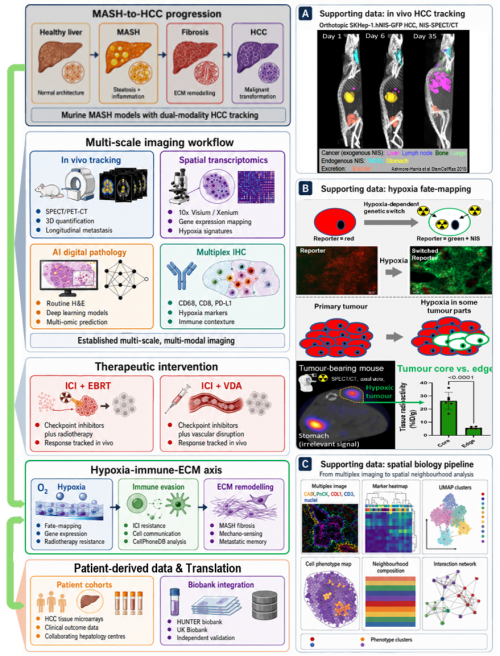
Figure 1. Project overview and work package interactions (left column) and supporting data (right column). Laboratory expertise: Gilbert Fruhwirth (multi-scale imaging, therapeutic interventions; Data A-B); Oscar Maiques (AI-driven digital pathology, spatial analysis; Data C).
Candidate background
Suitable candidates will have a minimum upper 2nd-class degree in cell biology/immunology/biochemistry or a closely related field with a strong background in cancer biology, an interest in advanced multi-scale imaging and multi-parametric analysis, and a passion for hypothesis-driven research. This is a highly multi-disciplinary project, and the student will employ a range of techniques including cell culture, mouse tumour models, diverse imaging technologies (i.e. SPECT/PET-CT, fluorescence microscopy, immunohistochemistry, spatial biology), fluorescence-activated cell sorting, transcriptomics, and computational methodologies for integrated data analysis. No prior programming experience is required – full training in computational and laboratory methods will be provided.
Potential Research Placements
- Anita Grigoriadis, Comprehensive Cancer Centre, King’s College London
- Mirjana Efremova, Barts Cancer Institute, Queen Mary University of London
- Claude Chelala, Barts Cancer Institute, Queen Mary University of London
References
- Siegel RL, Kratzer TB, Giaquinto AN, Sung H, Jemal A. Cancer statistics, 2025. CA Cancer J Clin. 2025;75(1):10-45. doi: 10.3322/caac.21871.
- Fruhwirth GO, Diocou S, Blower PJ, Ng T, Mullen GED. A whole-body dual-modality radionuclide optical strategy for preclinical imaging of metastasis and heterogeneous treatment response in different microenvironments. J Nucl Med. 2014;55(4):686-94. doi: 10.2967/jnumed.113.127480.
- Maiques O, Fanshawe B, Crosas-Molist E, Rodriguez-Hernandez I, Volpe A, Cantelli G, Boehme L, Orgaz JL, Mardakheh FK, Sanz-Moreno V, Fruhwirth GO. A preclinical pipeline to evaluate migrastatics as therapeutic agents in metastatic melanoma. Br J Cancer. 2021;125(5):699-713. doi: 10.1038/s41416-021-01442-6.
- Arslan S, Schmidt J, Bass C, Mehrotra D, Geraldes A, Singhal S, Hense J, Li X, Raharja-Liu P, Maiques O, Kather JN, Pandya P. A systematic pan-cancer study on deep learning-based prediction of multi-omic biomarkers from routine pathology images. Commun Med. 2024;4(1):48. doi: 10.1038/s43856-024-00471-5.
- Maiques O, Sallan MC, Laddach R, Pandya P, Varela A, Crosas-Molist E, Barcelo J, Courbot O, Liu Y, Graziani V, Arafat Y, Sewell J, Rodriguez-Hernandez I, Fanshawe B, Jung-Garcia Y, Imbert PRC, Grasset EM, Albrengues J, Santacana M, Macià A, Tarragona J, Matias-Guiu X, Marti RM, Tsoka S, Gaggioli C, Orgaz JL, Fruhwirth GO, Wallberg F, Betteridge K, Reyes-Aldasoro CC, Haider S, Braun A, Karagiannis SN, Elosegui-Artola A, Sanz-Moreno V. Matrix mechano-sensing at the invasive front induces a cytoskeletal and transcriptional memory supporting metastasis. Nat Commun. 2025;16(1):1394. doi: 10.1038/s41467-025-56299-7.