
Reprogramming vascular-immune interactions in human glioblastoma
Primary supervisor: Thomas Wälchli, UCL
Secondary supervisor: Kairbaan Hodivala-Dilke, Queen Mary University of London
Project
Glioblastoma (GBM) are very aggressive, highly vascularized and immunosuppressive brain cancers remaining one of the deadliest tumours [1,2]. Immunotherapies have revolutionised treatment of various solid cancers but fail against “immunologically cold” GBMs [2]. In GBM, an immunosuppressive tumour microenvironment (TME) and inter-and intratumoural heterogeneity contribute to immune evasion and limited therapeutic success. The blood-brain/tumour- barriers (BBB/BTB) play key role as gatekeepers of immune cell infiltration, but how they orchestrate GBM immune evasion is poorly understood.
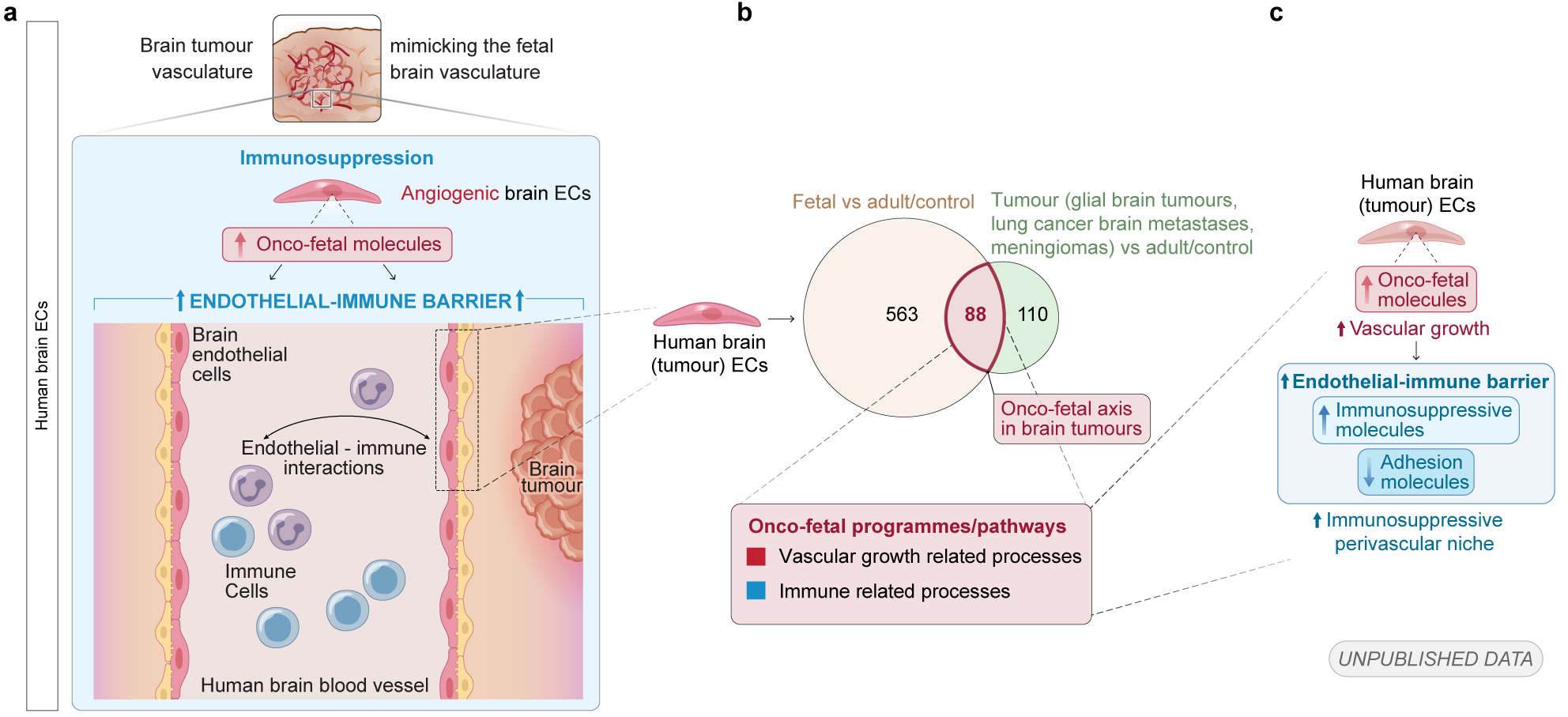
In peripheral tissues, remarkable parallels between developing tissues and tumours are well described, with active vascularisation creating immunologically privileged niches allowing undisturbed tissue growth. Whether this principle operates in the brain remains unresolved. Our recent breakthrough discovery identified reactivated developmental “onco-fetal programmes” in brain tumour vascular endothelial cells (ECs) revealing previously unrecognised endothelial-immune crosstalk in human GBMs [3-6] (Fig. 1a).
Evidence of substantial endothelial-to-perivascular cell crosstalk including vascular-immune interactions suggested a central role for the endothelium within healthy and diseased brain PVN networks [3,6]. However, how developmental programmes in ECs contribute to vascularization, BBB-establishment and immune-properties in healthy adult brain and to their alteration in disease (“onco-fetal reprogramming”) [3,6] remains unexplored.
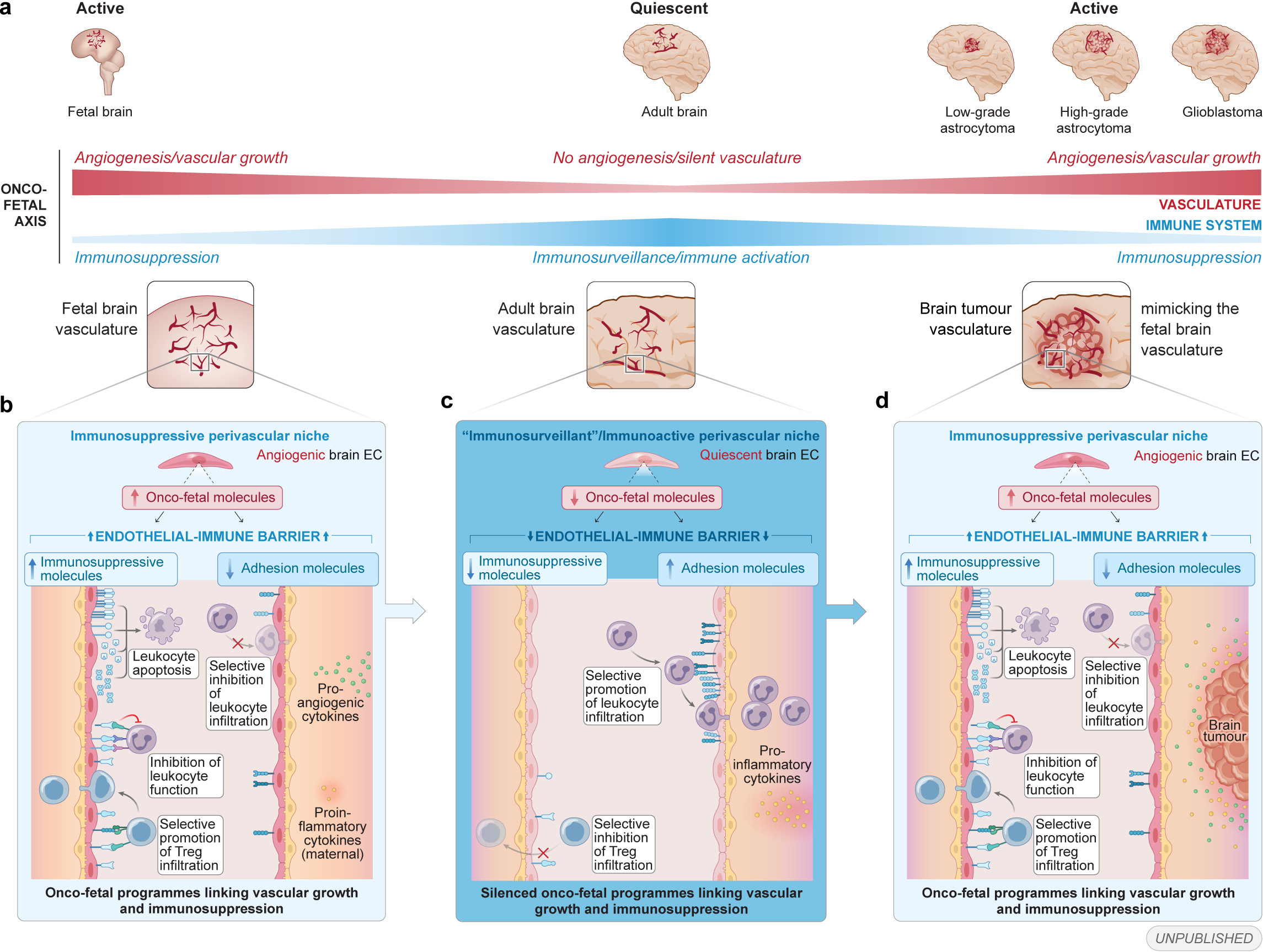
The central hypothesis of this project is that onco-fetal programmes promote vascular growth and create an endothelial-immune barrier and consequently immunosuppression in glioma (Fig. 1a, Fig. 2). and that modulating the onco-fetal-programmes-driven endothelial-immune-barrier reverts GBM immune-evasion and prolongs survival. Currently, glioma cells are thought to shape a reactive vasculature. Here, we embrace a novel paradigm, in which ECs are not passive bystanders, but actively regulate the endothelial-immune barrier as part of the BBB/BTB. We suggest these onco-fetal programmes fuel ECs to upregulate immunosuppressive- and downregulate cell adhesion molecules, thereby limiting leukocyte infiltration and inducing an immunosuppressive perivascular niche (PVN)/TME (Fig. 1b-e, Fig. 2).
Despite this revolution in our understanding of GBM endothelial biology, several questions remain unanswered:
- Question 1: Can we identify networks in endothelial cells that regulate the endothelial-immune barrier in human GBM?
- Question 2: How do these endothelial networks and the endothelial-immune barrier affect endothelial-immune cell interactions in the immunosuppressive human GBM PVN/TME?
- Question 3: How can we reprogramme these endothelial networks to revert the endothelial-immune barrier and promote an immune response in human GBM?
This CRUK City of London Centre PhD project will address these questions over the following aims:
- AIM 1: Identify brain tumour endothelial networks regulating endothelial-immune interactions in human GBM
- AIM 2: Assess spatial relationships of brain tumour endothelial-immune interactions in human GBM
- AIM 3: Reprogramme brain tumour endothelium by targeting regulatory networks to restore immunity in human GBM
Specifically, by combining single-cell (sc) and spatial multi-omics of human fetal brain and glioma tissues (AIMs 1, 2) in combination with human BBB/BTB-organoids (AIM 3), this PhD project will reveal how glioblastoma endothelium can be reprogrammed to regulate endothelial-immune interactions and restore immunity in human GBM.
Mechanistic insights into how the BBB/BTB endothelium actively regulates immune cell trafficking across the endothelial-immune barrier are currently unknown but will enable to i) modify the GBM immune landscape and ii) convert GBM into an “immunologically hot” tumour, rendering it less aggressive and more responsive to immunotherapies.
Candidate background
This PhD project would suit candidates with a background in brain vascular biology, cancer biology and/or immunology, ideally with laboratory computational experience in single-cell and spatial multi-omics and/or in 3D organoid culture and CRISPR/Cas9 technology.
References
- Wälchli, T. et al. Shaping the brain vasculature in development and disease in the single-cell era. Nat Rev Neurosci 24, 271–298 (2023). https://doi.org/10.1038/s41583-023-00684-y
- Lim, M., Xia, Y., Bettegowda, C. & Weller, M. Current state of immunotherapy for glioblastoma. Nat Rev Clin Oncol 15, 422–442 (2018). https://doi.org/10.1038/s41571-018-0003-5
- Wälchli, T. et al. Single-cell atlas of the human brain vasculature across development, adulthood and disease. Nature 632, 603–613 (2024). https://doi.org/10.1038/s41586-024-07493-y
- Schwab, M. et al. …Wälchli, T. Nucleolin promotes angiogenesis and endothelial metabolism along the oncofetal axis in the human brain vasculature. JCI Insight 8 (2023).
- Schwab, M. et al. …Wälchli, T. Onco-fetal protein Nogo-A restricts human and mouse glioma vascularization and growth via VEGF-Notch-hippo-metabolic signaling. bioRxiv, 2024.2010.2002.616320 (2024). https://doi.org/10.1101/2024.10.02.616320, ongoing PRE-SUBMISSION INQUIRY to Nature Neuroscience
- Wälchli, T. et al. Quantitative assessment of angiogenesis, perfused blood vessels and endothelial tip cells in the postnatal mouse brain. Nat Protoc 10, 53–74 (2015).