
Meet Dr Chris Tape where he talks about his latest publications in Cell and cover image
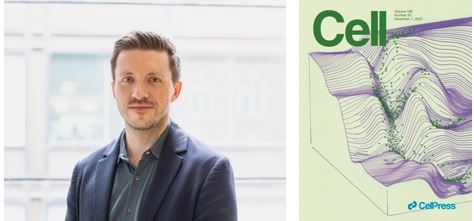
1. Congratulations on your recent two publications in Cell. Can you tell us the findings and their impact?
Cancer cells are regulated by oncogenic mutations and microenvironmental signals, yet these processes are often studied separately. In the first paper (Qin et al., Cell, 2023) we performed a systematic scRNA-seq and mass cytometry analysis of thousands of colonic organoid cultures regulated by: 1) oncogenic mutations, 2) fibroblasts and macrophages, 3) stromal ligands, and 4) signalling inhibitors.
We discovered a stepwise epithelial differentiation phenoscape dictated by combinations of oncogenes and stromal ligands, spanning from fibroblast-induced revival colonic stem cells (revCSC) to oncogene-driven hyper-proliferative CSC (proCSC).
To explore the role of stem cell polarisation in CRC therapy response, in the second paper (Ramos et al., Cell, 20230) we measured post translational modification (PTM) signalling, DNA-damage, cell-cycle activity, and apoptosis in >2,500 CRC patient-derived organoid (PDO) and cancer associated fibroblast (CAF) cultures in response to clinical therapies at single-cell resolution. We found that on-target cell-cycle blockage and DNA- damage drug effects are common, even in chemorefractory PDOs. However, drug- induced apoptosis is rarer, patient-specific, and aligns with a proCSC PTM signalling state. Crucially, we found that CAFs can regulate PDO plasticity — shifting mitotic proCSC to slow-cycling revCSC to protect cancer cells from chemotherapy. This may explain why highly-stromal CRC tumour respond so poorly to therapy: they have easier access to revCSC.
2. Can you tell us your personal journey and what inspired you to work on your research?
I’m originally from a small working-class market town in Essex and spent most of my youth getting into trouble. Thankfully, as a teenager I discovered molecular biology at A-level and totally fell in love with the concepts. I was the first person in my family to attend university and have been obsessed with understanding biological mechanisms ever since.
I have always been fascinated by how the same event in different contexts can lead to different outcomes. Context is everything. In tumours, cancer cells always sit alongside cells of the tumour microenvironment — so we need to contextualise oncogenic events relative to the local microenvironment. The problem is that there are so many possible mutations, stromal cells, and biochemical cues at play simultaneously that it’s hard to mechanistically understand how they co-regulate cancer. These combinatorial questions require combinatorial experiments.
Unfortunately, combinatorial experiments rapidly run into hundreds-to-thousands of different experimental conditions, and most technologies and data analysis approaches can’t handle that. We’re used to just looking at one or two things at a time. To overcome this challenge, my lab has spent years developing high-throughput organoid phenotyping technologies that can measure thousands of experimental conditions at single-cell resolution. We’ve then paired these wet-lab approaches with new computational methods to help us understand this complex data. Collectively, by investing in new method development, we can now perform highly combinatorial organoid phenotyping experiments that were previously impossible — leading to the insights in these two Cell papers.
I am inspired by biological curiosity, partnered with technological innovation. The famous computer scientist Alan Kay once said, “People who are really serious about software should make their own hardware”. I think a similar notion is also true in biology: people are really serious about biology should make their own methods. By developing methods alongside biological questions, we can address previously impenetrable questions. I like to do my science at the interface.
3. We are very proud to support you from the City of London Centre, what would you tell researchers who are not familiar with the Centre?
The CRUK City of London (CoL) Centre is a great initiative. London is such a powerhouse for science but it’s too-often spread across different universities and institutes. The CoL Centre helps unite multiple institutions under one common identity — which leads to the sharing of experience, expertise, resources and facilities.
Since its founding, the CoL Centre has really increased collaborations between UCL, the Crick, Barts Cancer Institute, and King’s and I regularly visit our partner institutes for thesis committees and collaborative meetings. The CoL Centre Development Funds are also extremely helpful to try out new ideas. In fact, our very first CoL Development Fund in 2019 directly led to the data in Figure 1 of Qin et al., Cell, 2023. If we’d not had the opportunity to true something new via the CoL Development Fund, we probably never would have published that paper.
4. What do you like to do outside work?
I have two young children so I enjoy sleep when possible.
For more information, please check the links below:
1. An oncogenic phenoscape of colonic stem cell polarization
https://www.cell.com/cell/fulltext/S0092-8674(23)01221-7
2. Trellis tree-based analysis reveals stromal regulation of patient-derived organoid drug responses
https://www.cell.com/cell/fulltext/S0092-8674(23)01220-5
3. Tweetorial
https://x.com/christophertape/status/1732792242501292245?s=20
4. Chris explaining the publications in a video
https://youtu.be/-ymmHnPChiA?si=cjxTv5NyTlH-L2f4