
Roles of liver metabolism in breast cancer development and response to therapy
Primary supervisor: Dimitrios Anastasiou, UCL
Secondary supervisor: Ilaria Malanchi, The Francis Crick Institute
Project
Cancer cells rewire their metabolism to support growth, survival, and dissemination [1-3]. Tumours also release cytokines, metabolites, hormones, and extracellular vesicles that influence the function of distant organs and reshape whole-body metabolism [4]. These systemic adaptations are thought to create conditions that promote tumour progression, metastatic dissemination, influence therapeutic responses and contribute to disease-associated morbidity [5].
The liver plays a central role in tumour-induced systemic metabolism. Tumour-derived signals reprogramme hepatic glucose, lipid, and amino acid metabolism, altering circulating nutrient availability and inflammatory signalling. Given its roles as both a metabolic hub and a major metastatic target organ, including in breast cancer, understanding the role of tumour-induced liver reprogramming could identify novel biomarkers for early cancer detection and uncover new ways to enhance the effectiveness of systemic treatments, incl. antibody therapies.
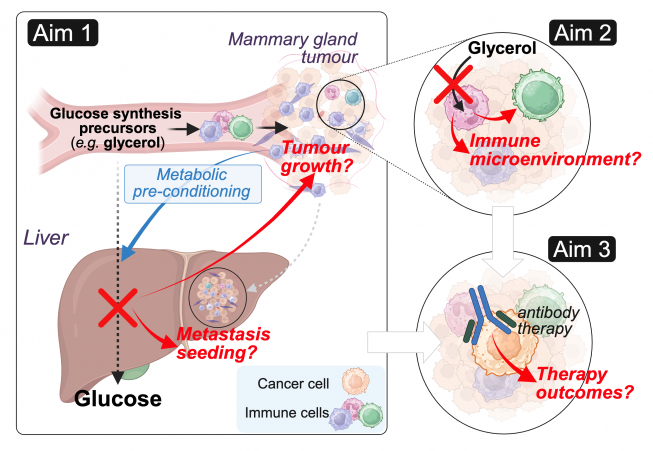
The Malanchi Lab has shown that mammary gland tumours elicit systemic inflammation that creates a pre-metastatic niche in distant organs, including the liver, and supports subsequent metastatic seeding. The Anastasiou Lab has discovered that mammary gland tumours lead to an early increase in hepatic glucose production. Leveraging these discoveries, the overarching goal of this project is to understand how tumour-induced changes in liver glucose metabolism influence anti-tumour immunity, mammary gland tumour progression, metastatic dissemination, and response to systemic therapy.
Aim 1: To assess the role of liver glucose metabolism in mammary gland tumour development, metastasis and their immune microenvironments. We will inject tumour cells directly into the mammary gland or systemically in mice lacking hepatic glucose-synthesis pathways (e.g. from glycerol) and monitor primary tumour growth and liver metastasis. To determine how hepatic gluconeogenesis influences anti-tumour immunity, we will profile immune cells in the blood, liver, and tumour immune microenvironment (TIME) using flow cytometry, single-cell RNA sequencing, metabolomics, and spatial transcriptomics.
Aim 2: To dissect how hepatic metabolism regulates anti-tumour immunity. Hepatic glucose synthesis depletes circulating metabolites, such as glycerol, that we have shown to be required for anti-tumour immunity. To establish whether the effects of hepatic gluconeogenesis on tumour growth and TIME are mediated through these metabolites, we will analyse immune-cell-specific knockout mice lacking key enzymes required for their utilisation. Comparison with liver-specific knockout models in Aim 1, and ex vivo mechanistic studies will define how hepatic metabolism regulates anti-tumour immunity and tumour progression.
Aim 3: To test the influence of the liver-immune metabolic axis on therapeutic response. Systemic immune functions determine the success of antibody-based therapies, including immune checkpoint inhibitors. Using mice from Aims 1 and 2, we will determine whether hepatic gluconeogenesis and the utilisation of gluconeogenic substrates by immune cells influence responses to clinically relevant antibody therapies for breast cancer. These studies will establish whether metabolic interactions between the liver and immune system can be targeted to improve systemic cancer therapy outcomes.
Candidate background
This project will be suitable for candidates with a strong interest in how metabolism and immunity are linked to cancer, and key associated techniques (mouse cancer models, flow cytometry, single-cell methods, metabolomics). A background in physiology, metabolism or immunology is desirable but not essential.
Potential Research Placements
- Julian Downward, The Francis Crick Institute
- Saeed Shoaie, King’s College London
- Mala Maini, UCL
References
- Grimm, F. et al. Metabolic priming by multiple enzyme systems supports glycolysis, HIF1α stabilisation, and human cancer cell survival in early hypoxia. EMBO J. 1–25 (2024) PMID: 38485816 (Anastasiou Lab)
- Clasen, F. et al. Systematic diet composition swap in a mouse genome-scale metabolic model reveals determinants of obesogenic diet metabolism in liver cancer. iScience 26, 106040 (2023) PMID: 36844450 (Anastasiou Lab)
- Anastasiou, D. Tumour microenvironment factors shaping the cancer metabolism landscape. Br. J. Cancer 116, 277–286 (2016) PMID: 28006817 (Anastasiou Lab)
- Swanton, C. et al. Embracing cancer complexity: Hallmarks of systemic disease. Cell 187, 1589–1616 (2024). PMID: 38552609 (Malanchi Lab)
- Rabas, N., et al. Cancer-induced systemic pre-conditioning of distant organs: building a niche for metastatic cells. Nat. Rev. Cancer 1–21 (2024) doi:10.1038/s41568-024-00752-0. PMID: 39390247 (Malanchi Lab)